Pick the wrong driveway shape and you’ll regret it every single day.
Back out onto a busy road in Bethesda during rush hour. Watch water pool against your garage because the grade runs the wrong direction. Squeeze past your spouse’s SUV and hope you don’t scratch the paint.
These are problems we fix constantly. And the fix usually means tearing out the old driveway and starting over.
The thing is, most of these headaches are avoidable. You just need to pick a driveway layout that actually fits your lot, your daily routine, and how your garage connects to the street. That’s what this guide is for.
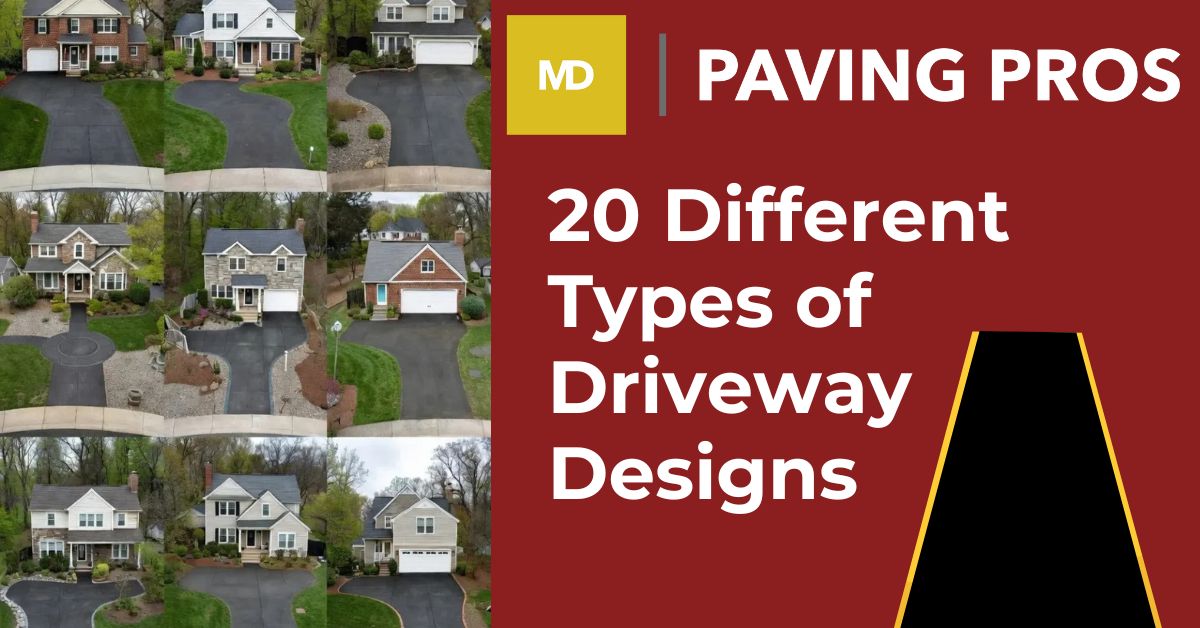
Below, you’ll find 20 different driveway configurations. Some are simple. Some are expensive. Some need a half-acre lot. Others fit on a 50-foot-wide suburban property. We’ll show you what each driveway costs, how much space it needs, and when it makes sense.
Quick Comparison: Driveway Types at a Glance
This table below shows the basics for each driveway shape. Costs assume asphalt installation in Maryland.
| Driveway Type | Min. Lot Width | Typical Cost | Best For |
|---|---|---|---|
| Straight | 25 ft | $1,400 – $3,000 | Small lots, tight budgets |
| Curved | 30 ft | $2,000 – $4,500 | Working around trees, slopes |
| Circular | 50 ft | $8,000 – $15,000 | Large lots, no backing out |
| Half-Circle | 40 ft | $5,000 – $10,000 | Medium lots, guest drop-off |
| Teardrop | 35 ft | $4,000 – $8,000 | Turnaround with one curb cut |
| U-Shaped | 55 ft | $10,000 – $18,000 | Estate homes, parallel approach |
| L-Shaped | 30 ft | $3,000 – $6,000 | Side-entry garages |
| T-Shaped | 35 ft | $3,500 – $7,000 | Extra parking + turnaround |
| Y-Shaped | 40 ft | $5,000 – $9,000 | Two destinations, one curb cut |
| Split | 35 ft | $4,500 – $8,000 | Multi-car families |
| Long Private | Varies | $8 – $12 / linear ft | Rural properties, 100+ ft |
| Shared | 16 ft min | Split with neighbor | Limited street frontage |
Three Things That Limit Your Driveway Options
Before you fall in love with a circular driveway on Pinterest, you need to know what’s actually possible on your lot.
Your Lot Size and Shape
You need about 50 feet of width for a circular driveway—anything less and cars can’t make the loop. Lots around here in Montgomery County usually run 50 to 75 feet wide. Some are smaller. So if your lot is 40 feet across? A circular driveway just won’t fit. Nothing you can do about it.
That rules out a lot of homes right from the start. You might be looking at a straight driveway, a curved one, an L-shape, or a teardrop instead.
Grab a tape measure and check your front yard before you fall in love with a design that won’t work.
Where Your Garage Sits
Where your garage is pretty much decides what shape driveway you can have. If your garage faces the street, a straight driveway usually works fine. But if your garage is on the side of the house, you’ll need a turn to get into it. So at that point, you’re looking at an L-shape or a curve. And if you’ve got a detached garage behind the house? That’s a longer driveway, probably with a bend or two.
The angle matters too. If your house sits at an angle to the street, a straight driveway might aim you at the lawn instead of the garage door.
Maryland Building Codes and HOA Rules
Local rules can kill a driveway plan fast. Montgomery County limits how much of your lot you can pave over. Howard County has setback requirements that push your driveway a certain distance from property lines. And your HOA? They might ban circular driveways completely or tell you exactly which materials you’re allowed to use.
You can’t skip any of this. Most driveway projects need permits, and the county will absolutely check your work. Save yourself the headache and call us, or your local permit office before you get too far into planning.
Standard Driveway Shapes
These three layouts cover 80% of residential driveways. They’re proven, affordable, and work on most properties.
Straight Driveways
A straight driveway runs directly from the street to your garage. No curves, no turns, no complications. Most are 10 to 12 feet wide for single-car access or 18 to 24 feet for two cars side by side.
Straight driveways are the cheapest option. In Maryland, asphalt runs $3 to $5 per square foot installed. A typical 12-by-40-foot driveway (480 square feet) costs $1,400 to $2,400. Concrete runs higher, usually $6 to $10 per square foot.

When straight works:
- Your garage faces the street
- Your front yard is shallow (under 50 feet)
- Budget is tight
- You don't mind backing onto the street
When it doesn't:
- You live on a busy road (backing out is dangerous)
- There's a tree or slope blocking the direct path
- Your garage is on the side of the house
Curved Driveways
A curved driveway bends gently from street to garage. One smooth arc, no sharp turns.
Why curve? Three reasons. There’s something in the way—like a big oak tree nobody wants to cut down. Or the slope of the yard works better with a curve. Or they just think straight driveways look boring.
Fair warning though: curves add 10 to 20 percent to the cost. You’re paying more for the curved forms and extra material on the outer edge. A curved asphalt driveway in Maryland runs somewhere between $2,000 and $4,500 depending on length.
Oh, and don’t make the curve too tight. Anything under a 20-foot radius feels weird to drive, and delivery trucks will end up cutting across your grass.


S-Shaped Driveways
Two curves in opposite directions. Left, then right. Or right, then left.
S-curves solve specific problems: obstacles on both sides of your approach, or a steep slope that needs a gentler path. They also slow traffic naturally, which matters if kids play in the front yard.
You need length for an S-curve to work. Under 40 feet, the curves feel cramped and the driveway looks awkward. If your front yard is shallow, stick with a single curve or go straight.
Circular and Loop Driveways
Circular driveway layouts let you drive in and drive out without reversing. They look impressive, handle guests well, and work great on busy roads. They also cost significantly more and need bigger lots.
Full Circular Driveways
A circular driveway loops completely around, connecting to the street at two points. Pull in one side, drive around, exit the other. The center usually gets landscaping, a fountain, or just open lawn.
Space requirements:
- Minimum front yard depth: 35 to 40 feet
- Minimum lot width: 50 feet (60+ looks better)
- Inside loop diameter: at least 12 feet
- Driveway width: 10 to 12 feet per lane
Cost runs $8,000 to $15,000 for asphalt in Maryland. That’s 2 to 3 times what you’d pay for a straight driveway of similar length because you’re paving the entire loop, not just a single lane.
Is it worth it? If you host parties, have multiple cars coming and going, or live on a road where backing out feels dangerous, yes. If you’re just parking two cars and rarely have guests, probably not.
Half-Circle Driveways
A half-circle connects to the street at two points but only makes a partial arc in front of your home. You get the drive-through convenience of a full circle without needing as much yard space.
These work well for colonial homes where the front door is a focal point. Guests pull up, passengers step out near the entrance, and the driver continues around to exit or park. You can squeeze a half-circle onto a lot with 25 to 30 feet of front yard depth, though 35+ feet looks more proportional.
Cost: $5,000 to $10,000 for asphalt, depending on the arc length and width.

Teardrop Driveways
Straight from the street, then a rounded bulb near the house for turning around. One curb cut, one connection to the road, but you can still pull in and drive out facing forward.
Teardrops fit where circular driveways don’t. Many Maryland jurisdictions only allow one curb cut per property. A teardrop gives you turnaround space within that limit.
Cost: $4,000 to $8,000, depending on the bulb size. Bigger bulbs mean easier turning but more paving.
Letter-Shaped Configurations
U, L, T, and Y. These layouts use angles and turns to solve specific problems: side-entry garages, multiple destinations, or the need for parking plus turnaround space.
U-Shaped Driveways
Two parallel legs running from the street, connected by a section near the house. Like a circular driveway stretched into parallel lines.
U-shapes work on properties where the house sits to one side of the lot. The legs run along the edges, keeping the center of the yard open. Common on estate properties in Potomac and Clarksville.
You need at least 55 feet of lot width and plenty of depth. Cost: $10,000 to $18,000. These are big installations.
L-Shaped Driveways
Enter straight, turn 90 degrees, reach the garage. Standard for side-entry garages where the door faces the side yard instead of the street.
| L-Shaped Driveway Specifications | |
|---|---|
| Driveway width (straight sections) | 10 to 12 feet |
| Width at the turn | At least 20 feet |
| Minimum lot width | 40 feet |
| Best for | Side-entry garages |
| Typical cost (asphalt) | $3,000 to $6,000 |
T-Shaped and Y-Shaped Driveways
A T-shape ends in a perpendicular cross section. A Y-shape splits into two branches. Both solve the same basic problem: you need to reach more than one spot from a single street connection.
T-shapes work when:
- You want parking space in front of the garage plus turnaround room
- Multiple cars need to park without blocking each other
Y-shapes work when:
- You need to reach two destinations (main garage + workshop, house + guest cottage)
- Two households share a single street entrance
Multi-Access and Extended Layouts
Split Driveways
One entrance from the street that divides into two lanes as it approaches the house. Different from a Y-shape because the split happens closer to the garage, not further back on the property.
Split driveways help multi-car families. Two drivers can come and go without the shuffle of moving cars. One lane leads to the garage; the other might lead to a parking pad or second garage bay.
Cost: $4,500 to $8,000, depending on how far back the split occurs.
Side-Entry and Rear-Entry Driveways
Side-entry driveways run along the side of the house to reach a garage facing sideways. Rear-entry driveways go past the house entirely, ending at parking behind the home.
Both hide cars from street view. Some neighborhoods prefer this. Some HOAs require it. The trade-off: more pavement, longer approaches, and you’ll usually need a turnaround area so you’re not backing the entire length when you leave.
Side-entry runs $4,000 to $8,000 depending on length. Rear-entry can cost $6,000 to $12,000+ because you’re paving a much longer path.
Long Private Driveways (100+ Feet)
Rural properties in Maryland often need driveways measured in hundreds of feet, not dozens. These installations have different requirements than suburban drives.
What changes with length:
- Base layer needs to be 6 to 8 inches thick (vs. 4 to 6 for standard)
- Drainage becomes critical, often requiring culverts or swales
- Grade changes compound over distance
- Cost is usually quoted per linear foot: $8 to $12 for asphalt
A 300-foot driveway at $10 per linear foot costs $3,000 just for the asphalt. Add base prep, drainage work, and any curves, and you’re looking at $8,000 to $15,000 or more.
Shared Driveways
A shared driveway serves two or more properties from one street connection. Common in older Maryland neighborhoods where lots were subdivided.
The appeal: split the paving cost, reduce curb cuts, use less of each lot for driveway. The risk: disputes. Who pays when it needs repaving? Who’s responsible when a tree root cracks the shared section? What happens if one neighbor wants to widen it?
If you're buying a property with a shared driveway:
- Get the recorded easement reviewed by your attorney before closing
- Verify who owns which portion
- Check for maintenance cost-sharing agreements
- Ask the seller about any past disputes
If you’re creating a new shared driveway, get a lawyer to draft the agreements. It costs a few hundred dollars now and prevents thousands in legal fees later.
Features You Can Add to Any Driveway
These are driveway additions that solve specific problems.
Turnarounds and Hammerheads
A hammerhead is a T or Y extension at the end of your driveway. Pull into one arm, back into the other, drive out facing forward. You get turnaround convenience without paving a full loop.
Size needed: 10 by 20 feet on each side of the main driveway. Cost: $1,500 to $3,000 to add to an existing driveway.
Worth it if: you live on a busy road, have a long driveway, or just hate backing up.
Motor Courts and Parking Pads
A motor court is an expanded parking area near the house, typically holding 4 to 8 vehicles. A parking pad is smaller, usually room for 1 or 2 extra cars beside the main driveway.
Motor courts cost $5,000 to $15,000 depending on size. Parking pads run $1,500 to $4,000. Both increase impervious surface, so check your county’s limits before adding.
Driveway Aprons
The apron is where your driveway meets the street. It usually extends from your property line to the road edge, covering the curb cut.
Aprons take abuse. Snowplows scrape them. Garbage trucks compress them. The transition from road to driveway stresses them. Many contractors recommend concrete aprons even when the rest of the driveway is asphalt because concrete handles the punishment better.
Replacing an apron costs $800 to $2,000 depending on width and material.
How to Pick the Right Driveway Type
| How to Choose the Right Driveway Type | |
|---|---|
| Step 1: Measure your lot | Front yard depth, lot width, distance from street to garage. Write them down. |
| Step 2: Note your garage position | Front-facing? Side-entry? Detached in back? This determines which shapes even work. |
| Step 3: Check regulations | Call your county permit office. Ask about impervious surface limits, setback requirements, and curb cut rules. Check your HOA if you have one. |
| Step 4: Think about daily use | Do you back onto a busy road every day? How many cars do you park? Do guests visit often? A driveway that doesn't fit your routine is a driveway you'll want to redo. |
| Step 5: Set a realistic budget | Circular driveways look great. They also cost 3x what a straight driveway costs. Know your numbers before you start comparing designs. |
Frequently Asked Questions About The Best Type of Driveway
Straight driveways account for roughly 70% of residential installations in Maryland. They connect directly from the street to a front-facing garage, typically measuring 10 to 12 feet wide for single-car access or 18 to 24 feet for two-car widths.
Straight layouts cost the least and work on almost any lot. The trade-off: you back onto the street every time you leave. If that bothers you or traffic is heavy, add a turnaround or choose a loop design.
Circular driveways cost 2 to 3 times more than straight driveways of similar approach length. A 12-by-40-foot straight asphalt driveway runs $1,400 to $2,400 in Maryland. A circular driveway with comparable approach length and a 30-foot loop runs $8,000 to $15,000.
The difference: square footage. A circle covers the approach plus the entire loop. Curved edges also take more labor to form than straight runs.
Small lots work best with straight driveways, L-shaped layouts, or teardrop turnarounds. These use space efficiently without needing the wide yards that circular or U-shaped driveways require.
On narrow lots, a straight driveway with a small hammerhead at the end gives you turnaround space without eating up your yard. For side-entry garages, an L-shape wraps the driveway along the property edge.
Most driveway changes that alter the curb cut, add paved area, or affect drainage require permits in Maryland. Simple resurfacing without size changes usually doesn’t. Adding turnarounds, widening, or changing shapes typically does.
Montgomery and Howard counties limit impervious surfaces, so expanding your driveway may trigger stormwater requirements like rain gardens or permeable paving. Check with your county’s permit office before starting.
Single-car access needs at least 10 feet, though 12 feels more comfortable. Two-car driveways need 18 to 24 feet. Add 2 feet if you regularly park trucks or large SUVs.
Maryland county codes set minimums, usually 9 to 10 feet for single lanes. Going wider costs more, increases runoff, and may count against impervious surface limits. Don’t oversize without reason.
Circular and half-circle driveways add the most perceived value because they signal a larger lot and higher-end home. Real estate agents report these layouts can add 5 to 10 percent to curb appeal assessments.
That said, a driveway that doesn’t fit your lot looks awkward. A cramped circle on a small yard hurts more than it helps. Best value comes from a shape that matches your lot’s proportions while being in good condition.
Get a Free Driveway Consultation
Still not sure which layout fits your property? We’ll come out, measure your lot, talk through your needs, and give you options with actual numbers. No pressure, no obligation.
We’ve installed over 1,500 driveways across Montgomery, Howard, Baltimore, and Anne Arundel counties. We know which layouts work on which lots, what the counties require, and how to avoid the mistakes that cost homeowners money.