A circular driveway creates a full loop in front of your home with two separate connections to the street. You drive in one entrance and exit the other without ever backing up. Most Maryland homeowners pay $8,000 to $15,000 for asphalt installation, and you need at least 50 feet of lot width to make the geometry work.
The appeal is obvious. No more backing onto busy roads in Bethesda during rush hour. No three-point turns when you have guests. Delivery trucks can pull through instead of blocking your driveway while they reverse.
But circular driveways eat up yard space and cost 2 to 3 times more than straight driveways. This guide will help you figure out if one fits your property, your budget, and your daily routine.
What Is a Circular Driveway?
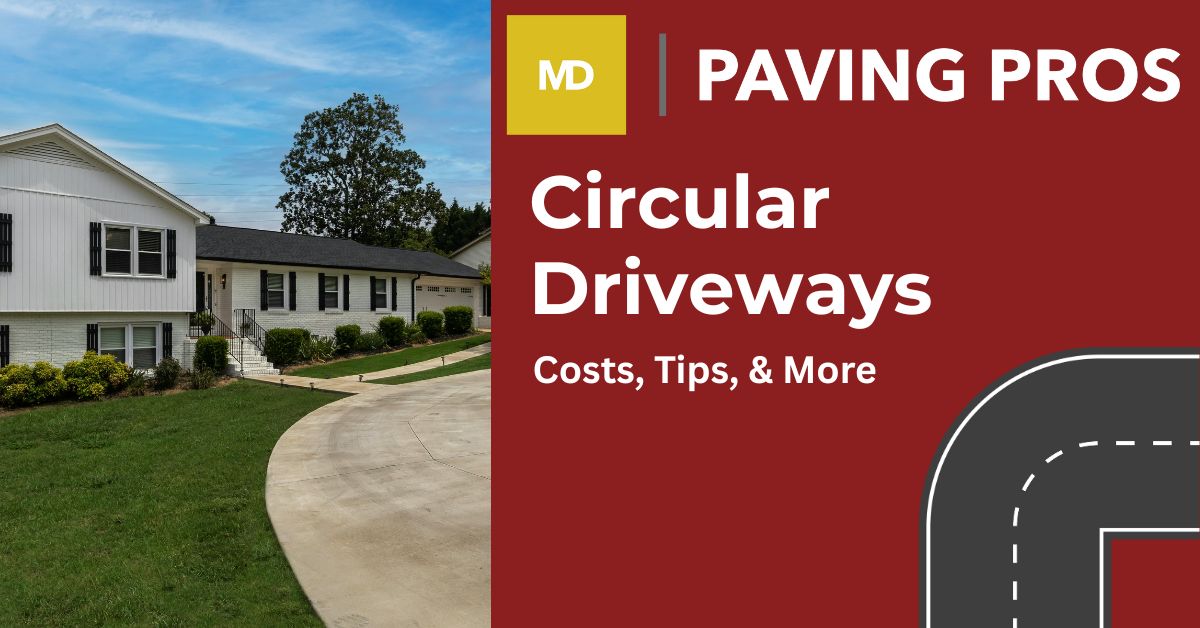
A circular driveway (also called a loop driveway or horseshoe driveway) connects to the street at two points and forms a continuous path around a center island. The island can hold landscaping, a fountain, a flagpole, or just open lawn.
The loop lets vehicles enter and exit in one continuous motion. Pull in the left entrance, curve around in front of the house, exit through the right entrance. Or vice versa. Either direction works.
Most people confuse circular driveways with half-circle driveways. Here’s the difference: A circular driveway makes a complete loop with the house sitting outside the circle. A half-circle only makes a partial arc and typically brings cars right up to the front door. Both have two curb cuts, but circular driveways need more space and cost more.
Circular Driveway Dimensions and Requirements
| Specification | Requirement |
|---|---|
| Minimum lot width | 50 feet (60+ feet looks better) |
| Minimum front yard depth | 35 to 40 feet from street to house |
| Driveway width | 10 to 12 feet per lane |
| Inner turning radius | 15 to 20 feet minimum |
| Center island diameter | 12 to 20 feet typical |
| Total paved area | 800 to 1,500+ square feet |
| Number of curb cuts | Two (entrance and exit) |
When Does a Circular Driveway Work?
Circular driveways solve real problems. They also create new ones if your property isn’t right for them. Here’s how to tell the difference.
A Circular Driveway Works When...
✓You live on a busy road and backing out feels dangerous
✓Your lot is at least 50 feet wide with 35+ feet of front yard depth
✓You host guests regularly and want easy drop-off access
✓Multiple cars come and go throughout the day
✓Your county allows two curb cuts on the same property
✓You want a statement entrance that sets your home apart
Skip the Circular Driveway If...
✗Your lot is under 50 feet wide (the curves won't fit properly)
✗Your front yard is shallow, under 30 feet from street to house
✗Local codes limit you to one curb cut
✗Your HOA prohibits circular driveways or limits impervious surface
✗Budget is tight (straight driveways cost 60 to 70 percent less)
✗You only park one or two cars and rarely have visitors
How Much Does a Circular Driveway Cost in Maryland?
Circular driveways in Maryland cost $8,000 to $15,000 for asphalt and $12,000 to $25,000 for concrete. The price depends on the total paved area, the material you choose, and how much grading and drainage work the site needs.
| Cost Factor | Typical Range | Notes |
|---|---|---|
| By Material | ||
| Asphalt | $8,000 to $15,000 | Most popular choice in Maryland |
| Concrete | $12,000 to $25,000 | Longer lifespan, higher upfront cost |
| Pavers | $18,000 to $35,000 | Premium look, easy repairs |
| Gravel | $3,000 to $6,000 | Budget option, needs regular maintenance |
| By Size (Asphalt) | ||
| Small (800 sq ft) | $6,400 to $8,800 | Tight loop, compact lots |
| Medium (1,200 sq ft) | $9,600 to $13,200 | Most common size in Maryland suburbs |
| Large (1,800+ sq ft) | $14,400 to $19,800+ | Estate homes, extra parking |
| Additional Costs | ||
| Old driveway removal | $1,000 to $3,000 | Depends on existing material and size |
| Grading and drainage | $500 to $2,500 | Steeper lots cost more |
| Center island landscaping | $500 to $3,000 | Basic grass to full landscaping |
| Decorative border or edging | $800 to $2,500 | Belgian block, brick, or stamped concrete |
| Permit fees | $100 to $500 | Varies by Maryland county |
| Second curb cut installation | $500 to $1,500 | Required for circular layout |
| Driveway lighting | $1,000 to $4,000 | Solar to hardwired options |
Why Circular Driveways Cost More Than Straight Driveways
A typical straight driveway (12 by 40 feet) covers about 480 square feet. A circular driveway with comparable approach length covers 800 to 1,200 square feet because you’re paving the full loop plus the approach.
Curved edges also require more labor to form than straight lines. Asphalt has to be hand-worked around curves, and concrete needs custom forms. Add two curb cuts instead of one, and you’re looking at 2 to 3 times the total cost of a straight driveway.
That said, circular driveways can add 5 to 10 percent to your property’s curb appeal assessment, according to real estate agents we’ve worked with in Bethesda and Potomac. The ROI depends on your neighborhood and what buyers expect.
How We Install Circular Driveways in Maryland
A circular driveway takes 3 to 5 days to install, depending on size and weather. Here’s what the process looks like from start to finish.
| Step | What Happens | Timeline |
|---|---|---|
| 1. Site Survey | Measure lot dimensions, mark utility lines, check drainage slope, and confirm the circular layout fits your property | 1 to 2 hours |
| 2. Permits and Approvals | Submit application for second curb cut, get county approval, and clear any HOA requirements | 1 to 3 weeks |
| 3. Demolition and Clearing | Remove existing driveway if present, clear vegetation, excavate to proper depth (8 to 12 inches for asphalt) | 1 day |
| 4. Grading and Base Prep | Establish proper drainage slope (1 to 2 percent away from house), compact soil, install 6 to 8 inches of crushed stone base | 1 to 2 days |
| 5. Curb Cut Installation | Cut into existing curb at both entrance and exit points, install aprons that meet county specifications | Half day |
| 6. Asphalt Installation | Lay hot-mix asphalt in 2 to 3 inch lifts, shape curves with precision, create smooth transitions at both street entries | 1 day |
| 7. Compaction | Roll entire surface with heavy roller while asphalt is still warm, pay extra attention to curved sections and edges | 2 to 4 hours |
| 8. Center Island Work | Install edging around island, add topsoil, plant grass or landscaping per your design plan | Half day to 1 day |
| 9. Finishing and Cleanup | Clean edges, remove debris, touch up any low spots, and verify drainage flows correctly | 2 to 3 hours |
| 10. Curing Period | Wait before driving on new surface, avoid turning wheels while stationary, keep heavy vehicles off during cure time | 3 to 7 days |
| Total Project Time: Roughly 1-2 weeks | ||
Circular Driveway Pros and Cons
Advantages
✓Safety: No backing onto busy roads. This matters on Georgia Avenue, Rockville Pike, and other high-traffic streets.
✓Convenience: Guests can drop off passengers at your front door without turning around.
✓Traffic Flow: Multiple cars can arrive and leave without shuffling vehicles.
✓Curb Appeal: Creates an impressive entrance that stands out in the neighborhood.
✓Delivery Access: Trucks can pull through instead of blocking your driveway.
Disadvantages
✗Cost: 2 to 3 times more expensive than a straight driveway.
✗Space: Uses a significant portion of your front yard.
✗Maintenance: More square footage means more to maintain, seal, and eventually repave.
✗Two Curb Cuts: Some jurisdictions only allow one driveway entrance per property.
✗Snow Removal: Plowing a circle takes longer and costs more than clearing a straight path.
Maryland Building Codes and Permit Requirements
Circular driveways require permits in most Maryland jurisdictions. The two main issues are curb cuts and impervious surface limits.
Curb Cut Rules
Montgomery County allows circular driveways for lots with 90 feet or more of street frontage. Narrower lots may qualify on a case-by-case basis depending on location and existing site conditions. The two curb cuts must be at least 20 feet apart.
Howard County has similar requirements. Each curb cut needs a Right of Way permit. Expect to pay $100 to $500 in permit fees, plus inspection costs.
Impervious Surface Limits
Maryland counties limit how much of your lot can be covered by hard surfaces like driveways, patios, and roofs. A circular driveway adds 800 to 1,500 square feet of impervious area. If you’re already close to your limit, you may need to add a rain garden or use permeable pavers to offset the new coverage.
We handle permits as part of every residential paving project. You don’t have to figure out county codes on your own.
Frequently Asked Questions About Circular Driveways
A well-designed circular driveway can add $5,000 to $20,000 to your home’s value, or, about a 5-10% percent increase in property value. In addition, homes with paved driveways sell 7 to 10 days faster than those with gravel, dirt, or irregularly maintained asphalt/concrete.
Asphalt circular driveways last 15 to 25 years with proper maintenance. Concrete versions last 25 to 40 years. Both require regular upkeep to reach the upper end of their lifespan. For asphalt, that means sealcoating every 3 to 5 years and filling cracks before they spread. For concrete, sealing every 2 to 3 years helps prevent scaling and staining.
A circular driveway forms a complete loop with the house outside the circle. A half-circle driveway creates a partial arc that typically brings visitors to the front door. Both have two curb cuts, but circular driveways need more space and cost more. Check our types of driveways guide for a full comparison of every layout option.
Get a Free Circular Driveway Estimate
Not sure if a circular driveway fits your property? We’ll come out, measure your lot, and tell you exactly what’s possible. No charge for the visit, no pressure to buy.
We’ve installed over 1,500 driveways across Montgomery County, Howard County, Baltimore County, and Anne Arundel County. We know which layouts work on which lots, what each jurisdiction requires, and how to avoid the mistakes that cost homeowners money.